Vector Wallpaper Design Templates: The Ultimate Editable Asset
Why Static Backgrounds Kill Your Creative Workflow
You know the frustration. You are building a landing page, designing a social media post, or mocking up a presentation, and you need a background that doesn't look like a generic stock photo. You find a JPEG that looks promising, but the moment you try to scale it or change a color, it turns into a pixelated mess. This is where the power of Vector Wallpaper Design Templates comes into play. Unlike raster images that are locked into a specific resolution, vector graphics are built on mathematical formulas. They are infinitely scalable. Whether you are designing a business card or a billboard, the lines stay crisp and the curves stay smooth.
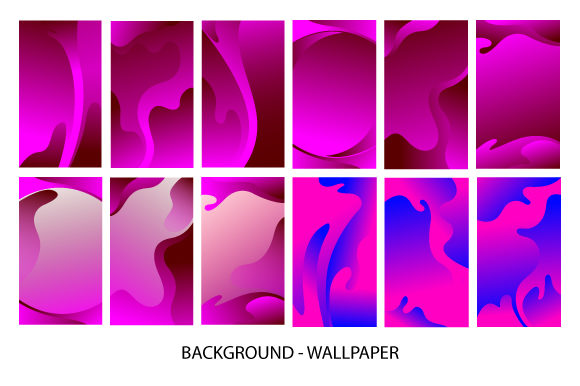
This specific collection is built for versatility. It includes a zip file containing 4 EPS files that are fully editable. If you have access to software like Adobe Illustrator, Affinity Designer, or CorelDRAW, you can open these files and manipulate every single anchor point. You aren't just buying a picture; you are acquiring a set of design assets that serve as a foundation for your own creativity. It is a practical solution for anyone who values efficiency and quality in their visual projects.
Visual Character and Style: More Than Just Shapes
When we talk about Vector Wallpaper Design Templates, we aren't talking about boring, flat colors. These templates typically feature complex layering, geometric precision, and modern aesthetics. They often utilize gradients, intricate line work, and abstract compositions that feel contemporary and professional. The "personality" of these files is versatile. They can feel futuristic and tech-forward, or organic and fluid, depending on how you edit the color palette. This flexibility makes them a premium font alternative for backgrounds—just as a good typeface anchors text, a strong vector background anchors the entire visual hierarchy of a design.
The appeal lies in the balance between complexity and editability. A good vector background adds texture and depth without overwhelming the foreground content. For a brand identity project, consistency is key. Using these EPS files allows you to extract specific color values or shapes to ensure your background matches your typography perfectly. It bridges the gap between display font aesthetics and structural layout design.
Practical Applications: From Screen to Print
The utility of a high-quality vector background spans almost every industry. For web design, these templates are gold. They load faster than high-res bitmaps and look stunning on Retina displays. You can use them as hero section backgrounds, overlaying them with a sans serif font for a clean, modern look, or a bold serif font for a touch of elegance.
Here is how different professionals can leverage these Vector Wallpaper Design Templates:
- Marketers and Advertisers: Use the EPS files to create consistent backgrounds for social media graphics across Facebook, Instagram, and LinkedIn. The scalability ensures your ads look sharp on mobile and desktop.
- Editorial Designers: When working on magazine layouts or e-book covers, a subtle vector pattern can add necessary depth behind a script font or handwritten font title without clashing with the text.
- Small Business Owners: You can use these templates for packaging design. Imagine a cosmetic box or a tech accessory sleeve with a sleek, custom-colored vector pattern wrapping around the sides. It screams professionalism.
- Presenters: Ditch the standard PowerPoint gradients. Import these vectors into Keynote or PowerPoint to create slide decks that look like they were designed by a professional agency.
Mastering the Edit: Working with the 4 EPS Files
Receiving a zip file with EPS files is exciting for a designer, but it requires a specific workflow. EPS (Encapsulated PostScript) is a standard vector format. To get the most out of these four files, you need to treat them as raw materials rather than finished products.
First, consider your font pairing. The background you choose dictates the typeface you can use. If the vector wallpaper has high contrast and sharp angles, a geometric sans serif font will complement it well. If the wallpaper features soft, organic waves, a transitional serif font or a light script font might be more appropriate. The goal is to avoid visual noise. The background should support the text, not fight with it.
Second, focus on color manipulation. Because these are vectors, you can select individual elements and change their hue to match your brand identity. If the template is blue and orange, but your brand is green and gold, you can re-color the entire file in minutes. This level of customization ensures that your logo design and marketing materials remain cohesive. You are not restricted to the default palette.
Evaluating Fit and Commercial Value
Before downloading and integrating these assets, evaluate the project fit. Does the style of the vector match the tone of your message? A chaotic, abstract vector might be great for a music festival poster but terrible for a corporate law firm's website. Always test the visual hierarchy. Place your text over the template and squint. Can you still read the headline? If the background is too busy, you may need to reduce the opacity or add a semi-transparent overlay.
From a commercial perspective, using Vector Wallpaper Design Templates is a smart investment. Instead of hiring a freelance illustrator to create a custom background for every new campaign, you have a library of four distinct styles that can be morphed into dozens of variations. This is the essence of modern modern typography and layout work—using modular assets to build unique creations efficiently. Whether you are crafting a digital ad or a physical flyer, the crispness of a vector ensures your work looks professional